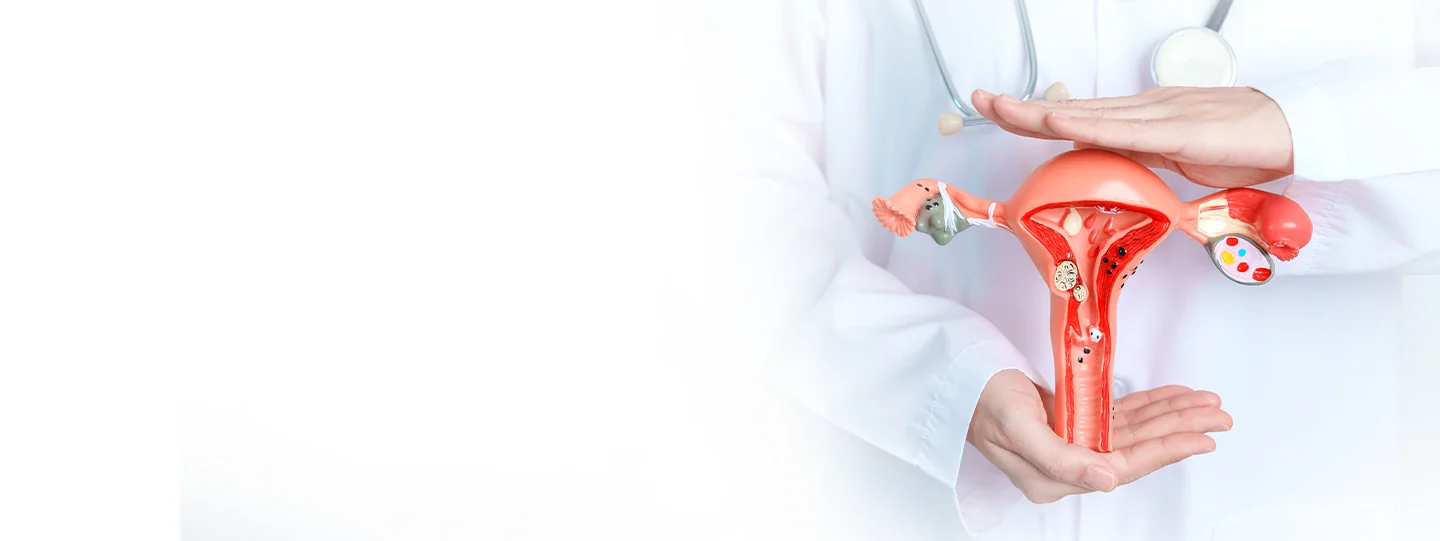
A mature cystic teratoma is a non-cancerous fluid-filled sac containing tissue from your hair, skin, teeth, or other body parts. These cysts arise from germ cells, often containing ectodermal tissues (hair, skin, teeth).
There is a difference between ovarian cysts and dermoid cysts. Unlike most ovarian cysts, dermoid cysts do not form in response to the menstrual cycle. Instead, like other dermoid cysts, they develop when completely developed tissue collects in an odd location (like the ovaries).
Most dermoid cysts in the ovaries don’t cause symptoms, especially when they are small. Usually, dermoid cysts do not affect menstrual cycles. However, as the cyst grows, the following symptoms may appear:
These cysts can become concerning if they cause complications such as:
Consult your best gynaecologists or gynaecologic surgeons at Surya Hospitals for an accurate and detailed diagnosis if you experience these symptoms.
Because they develop from pluripotent germ cells, embryonic cells that can become any tissue in the body.
These germ cells contain 3 layers that normally build all body tissues:
Read Also: Ovarian Cyst Laparoscopic Surgery & Treatment: Antibiotics, Dermoid Cysts & Recovery Guide
As these cysts don’t often cause symptoms, you may discover one during a routine imaging procedure. Doctors in India generally use the following diagnostic tools or methods for the right diagnosis:
Ovarian dermoid cysts become cancerous in less than 2% of cases, but there’s a higher risk of the tumour becoming cancer if:
Hence, a timely medical evaluation is required to prevent any complications.
Read Also: Ovarian Cyst Removal Surgery in India: Laparoscopic Procedure, Cost & Recovery Details
Not all ovarian dermoid cysts need to be removed through surgery. In most cases, a policy of "watchful waiting" is recommended. Your experts will consider the following before recommending surgery:
| Criterion | Management |
| Size < 6 cm, no symptoms | Watchful waiting with regular ultrasound |
| Size ≥ 6 cm | Surgical removal recommended |
| Symptomatic (pain, bloating) | Surgery |
| Suspicion of malignancy | Surgery with frozen section biopsy |
| Pregnancy | Usually monitored unless torsion/rupture occurs |
| Desire for future pregnancy | Cystectomy to preserve fertility |
Some types of mature cystic teratoma in the ovary eventually disappear on their own, but dermoid cysts stay unless they’re removed. Surgery is an effective cure for the cysts, and they grow back after removal in only 3% to 4% of cases.
Your, doctor, may choose between two options available, depending on how concerning the cyst is and your future family planning.
| Procedure | What’s Removed | Fertility Impact |
| Ovarian cystectomy | Only the cyst | Preserves the ovary and fertility |
| Oophorectomy | Entire ovary | Reduces fertility (one ovary remains) |
Ovarian cystectomy and Oophorectomy can be done through the following two techniques:
This is the preferred method in India in healthcare centres like Surya Hospitals because of its safety and quick recovery.
Benefits include:
During the procedure, the surgeon removes the cyst while preserving the ovary whenever possible (cystectomy).
In rare or complicated cases (very large cysts or suspicion of cancer), open surgery may be required. Open surgery involves a larger incision and longer recovery time.
Both are safe and effective methods done under professional guidance. However, like any other medical procedure, they can come with the risks
Contact a GP if you notice the following symptoms during your recovery:
These symptoms may indicate an infection.
Ovarian dermoid cysts are generally benign and highly treatable. All you need is timely diagnosis and appropriate non-surgical or surgical care; most women recover fully and return to normal life without complications.
Are you looking for the best treatment for an ovarian dermoid cyst?
Get expert care by contacting Surya Hospitals at +91-882882 8100; info@suryahospitals.com
Surya Hospitals, 101-102, Mangal Ashirwad, S.V. Road, Santacruz West, Mumbai – 400054.
Surya Hospitals, Shrikant Chambers-II, Beside R.K. Studio, Chembur, Mumbai, Maharashtra, 400071
Meet our experts:
Watch the celebrity testimonial for our services and read other written testimonials.
Q1: Is an ovarian dermoid cyst serious?
A: They are generally benign (non-cancerous) but can become serious if they cause complications such as ovarian torsion (twisting), rupture, or severe infection. Early medical evaluation is necessary.
Q2: What is the best treatment for a dermoid ovarian cyst?
A: Surgery (a laparoscopy or a laparotomy) is also normally recommended if there are concerns that the cyst could be cancerous or could become cancerous.



 +91 8828828100


 Previous
 Next
Next


