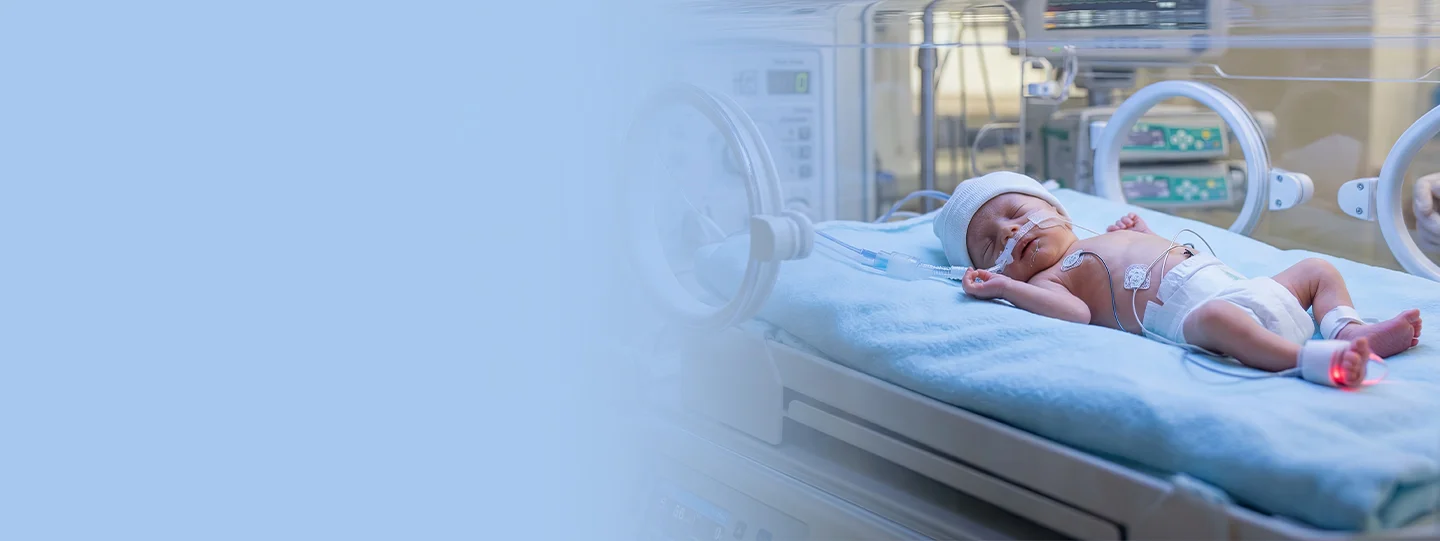
Here is the list of newborn complications that require NICU.
| Condition | Why it Happens |
| Respiratory Distress Syndrome (RDS) | Occurs in babies born early (premature) whose lungs are not fully developed. |
| Premature Birth (Means a Baby is Born too Early) | The birth takes place before the 37th week of pregnancy. |
| Jaundice | yellow color seen on the skin of many newborn babies due to high bilirubin levels. |
| Neonatal Infection | Primarily bacterial in origin, and include pneumonia, sepsis, and meningitis. |
| Low Blood Sugar (Hypoglycemia) | Feeding difficulties or maternal diabetes. |
| Feeding Problems | Weak sucking or swallowing. |
| Patent Ductus Arteriosus (PDA) | A heart defect that can develop soon after birth. It affects the way blood flows via a baby's lungs. |
| Temperature Instability | Baby cannot regulate body heat. |
NICU stands for neonatal intensive care unit, which is a specialized hospital unit equipped to provide advanced care to newborns.
The NICU at Surya Hospitals has advanced technology and trained healthcare professionals to give special care for the tiniest patients.
| Level | Typical Facility | Scope of Care |
| Level I | Newborn Care Corner (NBCC)/Postnatal ward | Routine newborn care and resuscitation |
| Level II | Special Newborn Care Unit (SNCU) | Care of stable preterm and moderately sick newborns |
| Level III | Tertiary NICU | Comprehensive neonatal intensive care including advanced ventilation and neonatal procedures |
| Level IV | Regional Referral NICU | Comprehensive medical and surgical neonatal care, advanced imaging, ECMO (where available), and multidisciplinary services |
The most common reasons include:
Let’s understand some of them:
A premature birth means a baby is born too early. The birth takes place before the 37th week of pregnancy.
They require NICU care immediately after birth because many organs are still developing.
A preterm, premature or “preemie” baby may struggle with:
A newborn can be:
Neonatal respiratory distress syndrome (RDS) is a condition that makes it difficult for babies to breathe.
It occurs when the air sacs (alveoli) in the baby’s lungs can’t open fully; means they can’t get sufficient oxygen to their blood.
Symptoms
Treatment
Doctors may use:
Sepsis in newborns (neonatal sepsis) is a serious medical condition that affects babies younger than 28 days old. Neonatal sepsis can affect any baby, but premature babies develop sepsis more often than full-term babies due to their immature immune systems.
Infections may occur:
Common causes include bacteria such as Group B Streptococcus and E. coli.
Warning Signs
Treatment
Neonatal sepsis treatment needs to begin immediately.
Treatment may include:
Infant jaundice is the yellow coloring of a newborn baby's skin and eyes because of a buildup of pigment called 'bilirubin' in the baby's blood.
Most cases are mild, but very high bilirubin levels require NICU treatment.
Treatment
A low blood sugar level in newborn babies is also called 'neonatal hypoglycaemia'. Treatment usually involves feeding, glucose gel, or IV glucose.
Some babies need NICU care because they are born with structural abnormalities affecting:
Examples include:
Treatment at Surya Hospitals' NICU care is based on the condition and may involve surgery or specialized medical care.
Yes.
Many advanced NICUs are designed to help parents stay close to their babies.
At Surya Hospitals, we often encourage parents to be involved in the following:
Learning that your newborn requires NICU care can bring a tsunami of emotions and questions. But it's important to remember that the neonatal intensive care unit isn't a place of hopelessness; it's a place of healing. All you need is to lean on the healthcare team and carefully understand what they are instructing.

Senior Consultant Neonatologist
Meet the doctor


 +91 8828828100


 Previous
 Next
Next


